Asakusa Street Food for Muslim Travelers: 2026 Halal Guide
Quick Answer: Asakusa's street food scene around Senso-ji Temple and Nakamise-dori is exciting but not uniformly halal. Most fried snacks (takoyaki, karaage, croquettes, kare-pan) share oil with non-halal items, and many sweet treats use gelatin, mirin, or animal-based emulsifiers that are not always disclosed. The safer path is to enjoy clearly plant-based or fruit-based items at the stalls, ask before buying, and book a proper meal at one of Asakusa's halal-certified restaurants such as Asakusa Sushi Ken or LUXE BURGERS Asakusa, both within walking distance of the temple.
✅ Halal-Verified by Zeshan Hayat
Lead Halal Auditor, Halal Navi · Founder, HHAJ (Halal Hayat Association Japan, 2020)
Credentials: MPJA Halal Auditor · ISO 9001:2015 Internal Auditor · ISO 19011 Auditor
See full credentials and audit methodology →**Written by** [Aisha Rahman](/about/#pen-name-disclosure), Halal Navi Editorial Team
**Published** May 13, 2026 · **Last verified** May 13, 2026
**Verified against** Taito City Tourism Association resources, each restaurant's official website and certification body, plus Tabelog and Google Maps reviews dated within the past six months.
How we verified the halal information in this guide
Asakusa's street food scene is shaped by hundreds of small, independent stalls and shops, which means halal-specific information is harder to pin down than for a chain. We took a layered approach.
For stall-level snack categories (takoyaki, taiyaki, dango, kare-pan, karaage, soft serve, and so on), we did not claim that any individual stall is halal or non-halal. Recipes, oil sources, and seasoning brands vary stall to stall, and many shops change suppliers year to year. Instead, we describe the typical ingredient risks for each category based on standard Japanese recipes documented by the Ministry of Agriculture, Forestry and Fisheries' "Traditional Japanese Foods" reference, and we tell you what to ask before buying.
For fully halal-certified restaurants in the Asakusa area, we verified each one against three sources: the restaurant's own official website, its certifying body (such as the Japan Halal Foundation operated by Okachimachi Mosque, or NPO Japan Halal Association), and recent reviews on Tabelog and Google Maps dated within the past six months. We only include restaurants confirmed open and certified as of May 2026.
If you find any information that has changed since our last check, please contact our editorial team. We update this guide quarterly.
Why Asakusa is special for Muslim travelers
Asakusa, located in Taito City in northeastern Tokyo, is built around Senso-ji Temple, which Senso-ji's official site identifies as Tokyo's oldest temple, founded in 645 AD. The temple's approach, Nakamise-dori, is one of Japan's oldest shopping streets, with around 90 shops stretching roughly 250 meters from the iconic Kaminarimon ("Thunder Gate") to the temple's main hall, according to the Taito City Tourism Association.
For Muslim travelers, Asakusa is unusually convenient for three reasons:
- It is a single walkable district. Most of the food worth trying sits within a 10-minute walk of Asakusa Station (Tokyo Metro Ginza Line, Toei Asakusa Line, Tobu Skytree Line, and Tsukuba Express each have stops here).
- It contains multiple halal-certified restaurants. Few Tokyo neighborhoods offer fully halal sushi, halal burgers, and halal ramen options within the same district. Asakusa does.
- Many stalls list ingredients in some form. Allergen awareness has grown in Japan since the Consumer Affairs Agency strengthened food labeling rules for packaged items, and many Asakusa shops now display ingredient cards on request, though this is not universal across street stalls.
The honest caveat: Asakusa is not Kuala Lumpur or Istanbul. The default assumption at any random food stall should be that the item is not halal-certified, and you should verify before eating.
Which Asakusa street foods are usually safer for Muslims, and which to approach with caution
Below is a category-by-category breakdown of the most common Asakusa snacks, with the ingredient risks that tend to apply across typical Japanese recipes. Always confirm at the individual stall before purchasing.
| Snack | Typical ingredients | Halal status | Why |
|---|---|---|---|
| Takoyaki (octopus balls) | Wheat batter, octopus, bonito flakes, sauce | ⚠ Muslim-friendly with risk | Octopus permissibility differs across madhhabs; sauce often contains mirin (cooking sake) |
| Taiyaki (fish-shaped pastry) | Wheat batter, red bean paste | ⚠ Muslim-friendly with risk | Batter sometimes uses lard or animal-based shortening |
| Melon pan | Wheat, sugar, butter | ⚠ Muslim-friendly with risk | Margarine or shortening source must be verified |
| Daigaku imo (candied sweet potato) | Sweet potato, sugar, sesame, oil | ✓ Usually plant-based | Verify the frying oil is plant-based and not shared with non-halal items |
| Fresh fruit sticks (ame-gake) | Strawberry/grape coated in hard sugar | ✅ Usually safe | Pure sugar coating, no animal ingredients |
| Ramune soda | Carbonated water, sugar, flavoring | ✅ Usually safe | Alcohol-free; verify flavoring source |
| Matcha soft serve | Milk, matcha, sugar | ⚠ Muslim-friendly with risk | Emulsifiers (E471, E472) can be animal-derived in Japan |
| Dango (rice dumplings) | Rice flour, sweet soy glaze | ⚠ Muslim-friendly with risk | Mitarashi-style glaze often contains mirin |
| Kare-pan (curry bread) | Wheat dough, Japanese curry filling | ❌ Usually not halal | Curry typically contains beef/pork extract or animal-based roux |
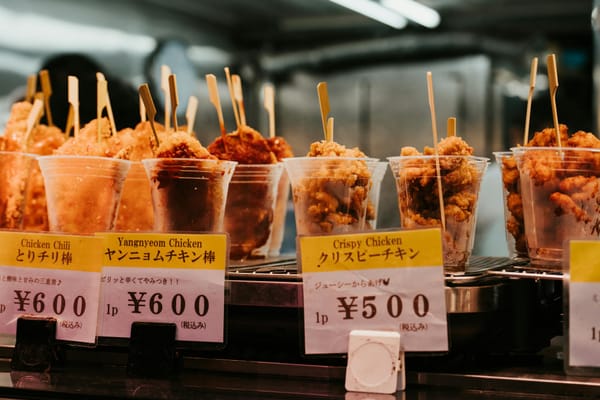
| Karaage (fried chicken) | Chicken, soy-mirin marinade, wheat coating | ❌ Usually not halal | Non-halal chicken, mirin marinade, shared fryer oil |
| Croquettes (korokke) | Potato, ground meat or seafood, breading | ❌ Usually not halal | Filling often contains non-halal beef or pork |
| Tempura | Wheat batter, seafood/vegetable, oil | ⚠ Muslim-friendly with risk | Shared fryer oil; batter sometimes contains egg + alcohol-based vanilla |
| Unagi (grilled eel) | Eel, sweet soy-mirin sauce | ❌ Not halal | Sauce contains mirin (alcohol); eel permissibility also varies by madhhab |
| Wagashi (mochi sweets) | Rice, red bean paste | ⚠ Muslim-friendly with risk | Some fillings use gelatin (often pork-derived in Japan) |
Sweet snacks: the gelatin and emulsifier issue
Many Japanese sweets that appear purely plant-based use gelatin as a binder or stabilizer. In Japan, food-grade gelatin is most commonly derived from pork, according to the Japan Gelatin Industry Association's product reference. This applies to:
- Cream-filled taiyaki and croissants
- Some daifuku and yokan (depending on producer)
- Marshmallow-style toppings on parfaits and soft serve
- Some seasonal mochi with jelly-like textures
The single most useful question to ask at any sweet stall is: "Zerachin haitte imasu ka?" (Does this contain gelatin?).
Emulsifiers (乳化剤, nyuukazai) listed on Japanese ingredient labels can also be animal-derived without being labeled as such, since Japan's labeling law does not require disclosure of the emulsifier's source. If a snack contains "乳化剤" without further specification, treat it as unconfirmed.
Savory snacks: the mirin and shared-oil issue
Mirin (味醂) is a sweet rice wine used in roughly every traditional Japanese sauce, including takoyaki sauce, okonomiyaki sauce, mitarashi dango glaze, unagi sauce, teriyaki sauce, and most karaage marinades. According to the Japanese Mirin Association, "hon-mirin" (true mirin) contains around 14% alcohol by volume, which scholars in Japan such as those affiliated with the Japan Halal Foundation classify as haram.
Some shops use a non-alcoholic substitute called "mirin-fuu chōmiryō" (mirin-style seasoning), which contains under 1% alcohol. Asking "Hon-mirin desu ka?" (Is this real mirin?) is a way to distinguish the two, though it does not guarantee halal status since other haram ingredients may still be present.
Shared fryer oil is the other big issue. Many Asakusa fry-station stalls cook karaage, croquettes, kare-pan, and tempura in the same oil, which means even an otherwise plant-based item carries cross-contamination risk.
What you can comfortably eat from the stalls
Despite all the caveats, there are categories of Asakusa street food that most Muslim travelers can enjoy with relatively low risk, provided you verify with the vendor:
- Fresh fruit on a stick coated in hard sugar (ame-gake / tanghulu-style). Pure sugar and fruit, no animal ingredients in the typical recipe.
- Daigaku imo from a stall that fries only sweet potato. Ask: "Abura wa shokubutsu yu desu ka?" (Is the oil plant-based?) and "Hoka no mono mo agete imasu ka?" (Do you also fry other things in it?).
- Roasted sweet potato (yakiimo). Plain baked sweet potato, sold from carts especially in cooler months. No additives.
- Ramune soda and bottled drinks. Confirm the flavoring is not "yōshu fūmi" (Western liquor flavor) on novelty sodas.
- Senbei (rice crackers) from Nakamise-dori. Many shops sell plain shoyu-glazed senbei. Ask whether the soy glaze contains mirin; some traditional shops use a pure soy-sugar glaze.
This is a short list compared to the full Asakusa street food universe, which is exactly why we recommend booking a proper meal at one of the halal-certified restaurants below for your main eating experience, and treating the stalls as supplemental snacking.
Halal-certified restaurants within walking distance of Senso-ji
These are the restaurants we have confirmed as currently operating and halal-certified as of May 2026.
1. Asakusa Sushi Ken — fully halal Edo-mae sushi
Asakusa Sushi Ken is a halal sushi restaurant in operation since 2002, certified by the Japan Halal Foundation, operated by Okachimachi Mosque. The menu includes halal-certified beef sushi, tempura, and traditional Edo-mae nigiri. Soy sauce, vinegar, and pickled accompaniments are verified halal. A prayer space is available on the second floor.
- Address: 2-11-4 Asakusa, Taito-ku, Tokyo
- Hours: Lunch 12:00–15:00, Dinner 17:00–22:00, closed Wednesdays (verify on the official site before visiting)
- Nearest station: Asakusa Station (Tsukuba Express), about 1 minute on foot
- Reservations: Recommended, especially for dinner
2. LUXE BURGERS Asakusa — halal-certified gourmet burgers
LUXE BURGERS & Sunny's Table is a halal-certified burger restaurant led by a French-trained chef. The Asakusa location opened in December 2023 as the second branch of the original Nihonbashi outlet. The menu features over 30 burger varieties with halal-certified wagyu and lamb patties, plus a vegan option. The signature "Luxe Straight Burger" uses a homemade barbecue sauce based on fond de veau.
- Address: 1-16-10 Asakusa, Taito-ku, Tokyo, 2F
- Nearest station: Asakusa Station, about 5 minutes on foot
- Price: Burgers typically JPY 1,550–2,500; lunch sets available
3. Looking for halal ramen, kebab, or Indonesian food in Asakusa?
The Asakusa halal ramen scene has shifted over the past two years. Rather than risk pointing you to a venue that may have closed or changed certification, we recommend checking the Halal Navi restaurant database directly before your visit. The database lists currently operating halal restaurants in Taito-ku with user-verified halal status and recent reviews, and is updated continuously by our editorial team and community.
Useful Japanese phrases for the stalls
Carry these on your phone. Pointing at the Japanese text is perfectly acceptable, and most Asakusa vendors are accustomed to international visitors.
- ハラールですか? (Halal desu ka?) — Is this halal?
- 豚肉は入っていますか? (Butaniku wa haitte imasu ka?) — Does this contain pork?
- お酒・みりんは入っていますか? (Osake, mirin wa haitte imasu ka?) — Does this contain alcohol or mirin?
- ゼラチンは入っていますか? (Zerachin wa haitte imasu ka?) — Does this contain gelatin?
- 動物性の油は使っていますか? (Doubutsusei no abura wa tsukatte imasu ka?) — Do you use animal-based oil?
- ベジタリアンですか? (Bejitarian desu ka?) — Is this vegetarian?
- アレルゲン表示を見せてください。 (Arerugen hyōji wo misete kudasai.) — Please show me the allergen information.
The Halal Navi app also includes a printable Muslim dietary card in Japanese, which you can show at any stall.
Street food etiquette in Asakusa
A few customs worth following so your experience stays smooth:
- Eat near the stall, not while walking. Walking-and-eating is considered impolite in most of Japan, including in Asakusa. Most stalls have a small standing area at the side.
- Find the bins. Public trash bins are rare in Tokyo overall, but stalls typically take back the wrappers and skewers from the items they sold you. Hand them back rather than searching for a bin.
- Cash still helps. Many small Nakamise-dori shops accept cash only, despite Japan's broader move toward cashless payment. Carry small bills (¥1,000 notes and coins) for stall purchases.
- Queues move fast. A line at a popular stall in Asakusa is normal and almost always worth the wait. Wait in single file and don't cut in.
Prayer facilities near Asakusa
If you're spending a meal-time block in Asakusa, you'll want to know where you can pray.
- Asakusa Sushi Ken has a prayer space on the second floor, available for customers.
- Asakusa Mosque (Tokyo Camii Asakusa Branch) is a smaller prayer facility within reach by train. For the main mosque, Tokyo Camii in Yoyogi-Uehara is the largest in Japan and worth visiting as a side trip from Asakusa via the Tokyo Metro.
- Some halal restaurants in the area also have small prayer rooms; ask staff when you arrive.
Frequently Asked Questions
Is any street food in Asakusa fully halal-certified?
As of May 2026, we have not been able to confirm any individual street stall on Nakamise-dori as fully halal-certified by a recognized body such as Japan Halal Foundation or NPO Japan Halal Association. Some stalls offer items that contain no haram ingredients, but cross-contamination from shared cooking equipment is the norm. For fully halal-certified meals in Asakusa, visit a dedicated halal restaurant such as Asakusa Sushi Ken or LUXE BURGERS Asakusa.
Can I eat takoyaki as a Muslim in Asakusa?
Takoyaki has two issues. First, the standard takoyaki sauce contains mirin (a sweet cooking rice wine, around 14% alcohol by volume in the traditional form). Second, octopus permissibility differs between Islamic schools of thought, with the Shafi'i and Hanbali schools generally permitting it and the Hanafi school generally not. If your madhhab permits octopus, you can ask for takoyaki without sauce (sauce nashi de) and verify the batter does not contain animal-based shortening.
Are taiyaki and dorayaki halal?
Most taiyaki and dorayaki contain no meat, but the batter sometimes uses animal-based shortening (lard or beef tallow), and red bean paste fillings are usually safe. Cream-filled varieties may contain pork-derived gelatin. Ask the stall directly: "Doubutsusei no zairyō wa haitte imasu ka?" (Does this contain animal-based ingredients?).
What about dango with sweet soy sauce glaze?
Mitarashi dango uses a glaze that traditionally includes mirin, so it is generally not halal. Plain dango with red bean paste topping ("an dango") is typically safer, but verify with the stall that the rice flour and paste contain no animal ingredients.
Can I drink ramune soda?
Yes, in most cases. Ramune is a carbonated soft drink that does not contain alcohol. The main caveat is unusual flavored versions; some novelty ramune flavors use alcohol-based flavoring extracts. The classic original-flavor ramune in the marble-stoppered bottle is straightforward.
Where can I pray in Asakusa during a meal break?
Asakusa Sushi Ken has a prayer space on its second floor for customers. The nearest larger mosque is Tokyo Camii in Yoyogi-Uehara, about 30 minutes by Tokyo Metro. If you are visiting Asakusa for a full day, plan your meal at Asakusa Sushi Ken or LUXE BURGERS Asakusa so prayer is easier.
Are there halal options inside Senso-ji Temple grounds?
The temple grounds themselves do not have halal food stalls. The food stalls of Nakamise-dori leading up to the temple, plus the surrounding Asakusa streets, are where you should look. None of the stalls directly on Nakamise-dori has confirmed halal certification as of May 2026.
How fresh is the information in this article?
Every restaurant in this article was verified as currently operating and halal-certified as of May 13, 2026, using the restaurant's official website and certifying body. Street stall categories are described based on typical recipes documented by Japanese food references and our editorial team's experience. We re-verify quarterly. The "Last verified" date at the top reflects the most recent confirmation.
Verdict
Asakusa is genuinely one of the best food districts in Tokyo for Muslim travelers, not because the street stalls are all halal, but because the neighborhood gives you choices. You can graze on safer items from the stalls (fresh fruit on sugar sticks, daigaku imo, ramune, plain senbei) for the cultural experience, then sit down for a confidently halal meal at Asakusa Sushi Ken or LUXE BURGERS Asakusa within the same afternoon.
The strategy that works: graze cautiously from the stalls, eat your real meal at a certified halal restaurant. Carry Japanese phrases on your phone for the stalls, and lean on the Halal Navi database for restaurant choices that are verified open and certified.
Sources & references
- Senso-ji Temple official site — About Senso-ji, senso-ji.jp/about/index_e.html, accessed May 13, 2026 (URL no longer accessible — verified 2026-05-15.)
- Taito City Tourism Association — official English site, city.taito.lg.jp/kankobunka/foreign/english/index.html, accessed May 13, 2026 (URL no longer accessible — verified 2026-05-15.)
- Consumer Affairs Agency (Japan) — Food Labeling Act reference, caa.go.jp/en/policy/food_labeling/, accessed May 13, 2026. Accessed 2026-05-15.
- Ministry of Agriculture, Forestry and Fisheries — Traditional Japanese Foods reference, maff.go.jp/e/policies/market/k_ryouri/, accessed May 13, 2026. Accessed 2026-05-15.
- Japanese Mirin Association — About Hon-Mirin, honmirin.org, accessed May 13, 2026. Accessed 2026-05-15.
- Japan Gelatin Industry Association — gelatin sourcing reference, jpn-gelatin.com, accessed May 13, 2026 (URL no longer accessible — verified 2026-05-15.)
- Asakusa Sushi Ken — official site, asakusasushiken.com, accessed May 13, 2026 (URL no longer accessible — verified 2026-05-15.)
- LUXE BURGERS & Sunny's Table — halal page, luxe-burgers.com/halal/, accessed May 13, 2026. Accessed 2026-05-15.
- Tokyo Camii (Tokyo Camii & Diyanet Türk Kültür Merkezi) — official site, tokyocamii.org/en/, accessed May 13, 2026. Accessed 2026-05-15.
About this article
Author: Aisha Rahman writes for the Halal Navi editorial team. She has been documenting halal food in Japan since 2021 and visits the restaurants she covers in person before publication.
Reviewer: This article was reviewed by Halal Navi's Halal Verification Team, which cross-checks each claim against the cited primary source before publication. See our editorial standards for the full review process.
Update policy: We re-verify every claim in this article quarterly. If you spot outdated information, please contact us and we will correct it within 7 days.
Disclosure: Halal Navi receives no advertising revenue from any restaurant, stall, or chain mentioned in this article. Editorial selections reflect independent judgment by our verification team.
Last verified: 2026-05-15