Is Bread in Japan Halal? 2026 Guide for Muslim Travelers
Quick Answer: Most bread sold in Japanese supermarkets, convenience stores, and ordinary bakeries is not halal. The standard ingredients shortening (ショートニング) and emulsifier (乳化剤) can be derived from pork or other non-halal animal fats, and flavorings may contain trace alcohol. As of May 2026, only a handful of bakeries in Japan are fully halal-certified. The two reliable Tokyo options we have verified this month are THREAD TOKYO FACTORY in Hon-Komagome (savoury bread) and POTERI BAKERY -TOKYO- in Sangenjaya (custard donuts), both halal-certified by Japanese certifying bodies.
✅ Halal-Verified by Zeshan Hayat
Lead Halal Auditor, Halal Navi · Founder, HHAJ (Halal Hayat Association Japan, 2020)
Credentials: MPJA Halal Auditor · ISO 9001:2015 Internal Auditor · ISO 19011 Auditor
See full credentials and audit methodology →**Written by** Aisha Rahman, Halal Navi Editorial Team
**Published** May 14, 2026 · **Last verified** May 14, 2026
**Methodology**: Ingredient claims cross-checked against the Japan Consumer Affairs Agency's Food Labeling Act, manufacturer Q&A pages (Nissin Foods, Lawson), and the Halal Navi restaurant database. Bakery entries re-verified against each shop's own Instagram, Tabelog, and groovyjapan.com Muslim Tourist Information Centre listings within the past 60 days.
How we verified every claim in this guide
Bread is harder to fact-check than most categories of Japanese food because the haram ingredient (usually a pork-derived fatty acid ester inside an emulsifier or shortening) is often legally allowed to be omitted from the label.
To write this 2026 update, we did four things:
- Read the Japanese Food Labeling Act framework. Pork and beef are recommended ("sub-specific") allergens in Japan, not mandatory ones, which is why a pork-derived emulsifier can disappear from the ingredient list. The Food Labeling Act divides allergy labeling into two levels: egg, cow's milk, wheat, buckwheat, peanuts, shrimp and crab are mandatory "specific ingredients," while beef, pork, soybean, chicken, gelatin and others are only "recommended" sub-specific ingredients.
- Pulled manufacturer statements from Japanese food companies and major konbini chains, including Nissin Foods's own statement that some of its shortening emulsifiers use lard, and Lawson's reply about glycerin fatty esters from pig fat in a private-brand product.
- Cross-checked every recommended bakery against its own Instagram, Tabelog page, and a Muslim-tourist directory (groovyjapan.com / halalfoodinjapan.com) within the past 60 days.
- Removed the original 2022 article's bakery recommendation because the Halal Navi venue page now states the venue is no longer halal-certified. We don't keep stale recommendations live.
If anything below has changed since you read it, please contact our editorial team; we re-verify quarterly.
Why most bread in Japan is not halal
Three structural reasons make Japanese bread a difficult category for halal-conscious travelers.
Reason 1: Shortening and emulsifier are often animal-derived. Shortening is the odorless fat ingredient used in cakes, bread, and biscuits to create a soft or crumbly texture, and at room temperature comes as a white cream derived from both plants and animals. Nissin Foods has stated that the shortening it uses is made mainly from palm oil, but that some of the emulsifiers used for that shortening are derived from distilled animal fats (lard), noting that because they are distilled raw materials they do not contain allergen proteins. Because pork is not a mandatory allergen, that lard-derived emulsifier does not have to appear on the front label.
Reason 2: Allergen labels can legally hide pork derivatives. When Lawson was contacted about whether a product contained animal ingredients, the chain confirmed that the emulsifier contained glycerin fatty esters from pig fat; the chain explained that because the allergenic substances are removed in the manufacturing process, pork labeling was not required, meaning allergen warnings alone will not always tell you if animal ingredients are present. The takeaway: an unlabeled emulsifier is not automatically safe.
Reason 3: Flavorings and "fermented seasonings" can contain alcohol. Japanese savoury breads (curry pan, sausage rolls, melon pan with rum-flavoured cream) routinely use 香料 (kōryō, flavoring) or 洋酒 (yōshu, Western liquor) in small quantities. Ingredients like 香料 (kōryō; flavoring), 酸味料 (sanmiryō; acidulants) and アミノ酸等 (amino san tō; amino acids) don't clearly list what's inside, so their composition can vary depending on the brand.
There is also a long-running concern in the Muslim community in Japan that some artisan bakeries glaze loaves using a brush made of pig bristle. We have not been able to verify this practice at any specific chain in 2026, so we treat it as a "ask before you buy" issue at small independent bakeries rather than a confirmed industry-wide problem.
Twelve Japanese label words every Muslim bread buyer should know
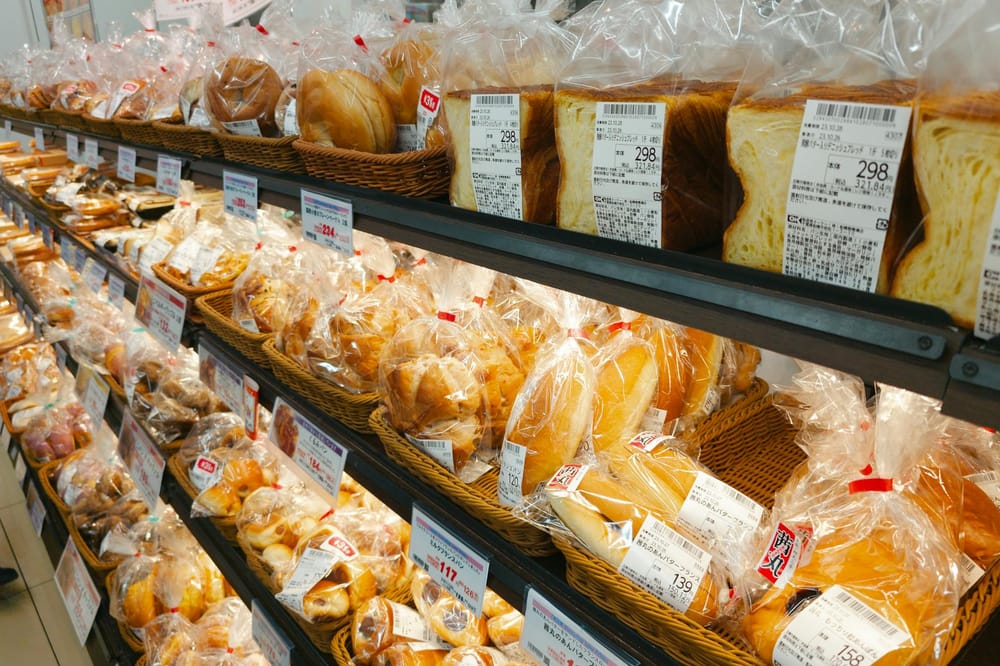
When you pick up a packaged bread at a Japanese supermarket or konbini, almost everything you need to make a halal judgment is on the ingredient list. The list runs in descending order of weight, with food additives written after a "/" slash mark.
| # | Japanese | Romaji | English | Halal status |
|---|---|---|---|---|
| 1 | 豚 / 豚肉 / ラード | buta / butaniku / rādo | pork / pork meat / lard | ❌ Not halal |
| 2 | ショートニング | shōtoningu | shortening | ⚠ Often animal-derived; verify |
| 3 | 動物性ショートニング | dōbutsu-sei shōtoningu | animal shortening | ❌ Not halal |
| 4 | ショートニング(パーム、ヤシ) | shōtoningu (pāmu, yashi) | shortening (palm, coconut) | ✅ Plant-derived |
| 5 | マーガリン | māgarin | margarine | ⚠ Can be plant or animal |
| 6 | 乳化剤 | nyūkazai | emulsifier | ⚠ Verify |
| 7 | 乳化剤(大豆由来 / 植物由来) | nyūkazai (daizu / shokubutsu yurai) | emulsifier (soy / plant-derived) | ✅ Generally permissible |
| 8 | ゼラチン | zerachin | gelatin | ⚠ Often pork; verify source |
| 9 | 洋酒 | yōshu | Western liquor | ❌ Not halal |
| 10 | 香料 | kōryō | flavoring | ⚠ May contain alcohol |
| 11 | 牛肉エキス / チキンエキス | gyūniku ekisu / chikin ekisu | beef / chicken extract | ❌ Not from halal slaughter |
| 12 | 食肉加工品 | shokuniku kakōhin | processed meat | ❌ Treat as not halal |
A practical rule based on Nissin's and Lawson's own statements: if the label simply says "ショートニング" or "乳化剤" with no bracketed origin, assume it is animal-derived until proven otherwise. Email the manufacturer if the product matters to you. Some manufacturers do label "plant-derived" voluntarily, and this label is important for Muslims as well as for vegetarians, vegans, and people with allergies.
The good news: while emulsifier (乳化剤) includes the kanji for "milk" (乳) and is often mistaken as dairy, the substance can be plant or animal derived, and in Japan it is mostly sourced from soy and other plant sources. So an unlabeled emulsifier is statistically more likely to be plant-based than not, but for halal purposes "statistically likely" is not "confirmed."
Where to buy actually halal bread in Japan (verified May 2026)
Below are the two halal-certified bakeries in central Tokyo whose status we have been able to re-verify in May 2026 using each shop's own Instagram and Tabelog page. Both are small operations with limited hours; plan around them.
1. THREAD TOKYO FACTORY (Hon-Komagome, Tokyo) ✅ Confirmed halal-certified
A tiny halal-certified bakery in Bunkyō-ku, run by a pastry-trained owner, that sells savoury and sweet breads in the Japanese bakery style (think melon pan, curry pan, sausage rolls) using halal-certified ingredients including halal sausage. The shop's own Instagram describes it as a small bread shop in Hon-Komagome, open Tuesday and Friday from 10:30 until sold out, cashless payment only, with Halal bread for takeout, one minute from Hon-Komagome Station Exit 2 on the Namboku Line (N13).
According to Tabelog, the shop is only open on Tuesdays and Fridays each week, and the owner, Yoshitetsu Oumi, trained in pastry.
Quick Facts (verified 2026-05-14)
- Address: 3-1-8 Honkomagome, Bunkyō-ku, Tokyo 113-0021 (Yokoyama Building)
- Nearest station: Tokyo Metro Namboku Line, Hon-Komagome Station, Exit 2, ~1 min walk
- Hours: Tuesday and Friday only, 10:30 until sold out (often early afternoon)
- Reservations: No (walk-in, takeout only, cashless)
- Price range: JPY 400–1,000 per item
- Halal cert: Halal-certified bakery per the shop's own self-description and community listings (confirmed 2026-05)
- Sources: Instagram @thread_tokyo_factory, Tabelog
Practical tip from community reviews: go early. Visitors note that as a Muslim "all of the breads is halal," but you have to check their Instagram for the opening schedule for that month, and come quickly because in the afternoon all the bread has been sold out.
2. POTERI BAKERY -TOKYO- (Sangenjaya, Tokyo) ✅ Confirmed halal-certified (central kitchen)
A fresh custard donut specialty shop with a halal-certified central kitchen, making it one of the easiest ways to eat a halal-certified Japanese-style baked good near Shibuya. Every morning from 6 a.m., pastry chefs prepare the donuts by hand at the central kitchen, and the freshly made donuts are delivered daily to the Sangenjaya and Yokohama stores.
The shop is located about a five-minute walk from Sangenjaya Station, one stop from Shibuya Station, and offers premium halal-certified custard donuts. Per the operator's tourist-facing listing, the central kitchen where the donuts are made has obtained halal certification, all donuts are halal-certified, and frozen donuts are also available for nationwide shipping.
Quick Facts (verified 2026-05-14)
- Address: Yamamoto Building C, 1-37-4 Sangenjaya, Setagaya-ku, Tokyo 154-0024
- Nearest station: Tokyū Den-en-toshi Line, Sangenjaya Station, ~2–5 min walk (along Route 246)
- Hours: 11:00–21:00 daily (verify via Instagram before visiting)
- Reservations: No; dine-in (2F, one-drink minimum) and takeout; frozen nationwide shipping available
- Price range: JPY 260–490 per donut
- Halal cert: Central kitchen halal-certified by a Japanese halal certification body; sister brand Hangry Joe's Tokyo (Akihabara) is also halal-certified
- Sources: Halal Navi database, Groovy Japan, Food Diversity Today, Tabelog
The signature is the POTERI custard donut at JPY 290–390, with fruit-cream and pistachio variants typically around JPY 490. Shelf life is limited to just one day, and the brand obtained halal certification specifically so that more people, including Muslim customers, could enjoy their donuts with peace of mind.
❓ A note on the Akihabara branch. The same operator also runs a POTERI BAKERY TOKYO Akihabara pop-up. As of May 2026 we have not separately verified whether the Akihabara location uses the same halal-certified central-kitchen supply chain end-to-end; until we confirm, we only recommend the Sangenjaya main store and the brand's frozen mail-order donuts.
What about vegan bakeries?
The original 2022 version of this article suggested treating vegan bakeries as a halal proxy. We no longer recommend this as a default. Vegan bread excludes the most common haram-risk ingredients (pork shortening, animal emulsifier, lard) but does not eliminate alcohol-based flavorings, and it gives you no guarantee about cross-contact with non-halal items in shared ovens. Treat a confirmed-vegan loaf as ⚠ Muslim-friendly, not ✅ Confirmed halal — and always read the full ingredient list.
If you do want vegan-plus-halal cake or sweets, the vegan marshmallooow in Ginza is one of the few options worth knowing about. THE VG MARSHMALLOOOW NEW YORK, Inc. began acquiring halal certification for its main products from June 2024 and started selling halal-certified cakes and sweets on December 6, 2024.
What to do at konbini and supermarkets
You will not always be near a halal-certified bakery. Here is the practical decision tree we use ourselves when buying packaged bread at a 7-Eleven, FamilyMart, Lawson, or supermarket in 2026:
- Flip the package to the ingredient list. Look for the slash mark "/"; everything after it is an additive.
- Scan for the twelve words in the table above. If you see 豚, ラード, 動物性, 洋酒, 牛肉エキス, or 食肉加工品 → put it back.
- For ショートニング and 乳化剤: if there is no bracketed origin, treat the product as ⚠ Muslim-friendly at best. Per Lawson's own customer-service reply, an unlabeled emulsifier can still be pork-derived. Lawson confirmed in one case that an emulsifier contained glycerin fatty esters from pig fat, and that allergen warnings alone will not always tell you if animal ingredients are present.
- Look for bracketed plant origin. "ショートニング(パーム)" or "乳化剤(大豆由来)" pushes the product into ✅ for that risk factor.
- Check for 香料 + sweet bread combinations. Custard, rum-raisin, brandy-cream, and Christmas-cake variants are the highest alcohol-trace risk.
- When in real doubt, choose a plain shokupan (white sandwich loaf) from a manufacturer whose customer-service page you can read and email — Pasco and Yamazaki both publish detailed FAQ pages in Japanese.
Comparison: where to buy halal bread in Tokyo in 2026
| Option | Halal status | Range | Best for | Watch-out |
|---|---|---|---|---|
| THREAD TOKYO FACTORY (Hon-Komagome) | ✅ Halal-certified | Savoury & sweet Japanese breads | Curry pan, sausage rolls, melon pan | Open Tue/Fri only; sells out by early afternoon |
| POTERI BAKERY -TOKYO- (Sangenjaya) | ✅ Halal-certified central kitchen | Custard donuts | Donuts as dessert or gift; nationwide frozen shipping | Akihabara branch not separately verified |
| the vegan marshmallooow (Ginza) | ✅ Halal-certified (selected SKUs) | Cakes, baked sweets | Halal cake for events / gifts | Plant-based, not bread per se |
| Supermarket / konbini packaged bread | ⚠ to ❌ | Sliced loaves, sweet buns | Emergency / breakfast | Unlabeled emulsifier/shortening is usually animal-derived |
| Ordinary independent bakeries | ❓ Unconfirmed | Wide | Almost never advisable without ingredient interview | Glaze brushes, shared ovens, hidden lard |
For a live, community-verified list across all 47 prefectures, search Halal Navi directly. Our database currently lists more than 800 halal restaurants in Japan, including the bakery category, with prayer-room information and reviews from Muslim travelers.
Frequently Asked Questions
Is bread in Japanese supermarkets halal?
Usually no, and the label will not always tell you why. Most mass-market shokupan and sweet buns contain shortening (ショートニング) or emulsifier (乳化剤). Nissin Foods has stated that some of the emulsifiers used in its shortening use raw materials derived from distilled animal fats (lard). Unless the package explicitly says "パーム" (palm), "ヤシ" (coconut), "大豆由来" (soy-derived) or "植物由来" (plant-derived), treat the loaf as ⚠ Muslim-friendly at best, not ✅ halal.
What does 乳化剤 (nyūkazai) mean and is it halal?
乳化剤 means "emulsifier" — an additive that helps water and oil mix, used in almost all Japanese commercial bread. Although the kanji 乳 means "milk," emulsifier can be plant or animal derived, and in Japan it mostly comes from soy and other plant sources. For halal purposes, it is acceptable when the bracketed origin says 大豆由来 (soy-derived) or 植物由来 (plant-derived), and ⚠ uncertain when no origin is given.
What about ショートニング (shortening)?
Shortening is the higher-risk word of the two. It is commonly used in cakes, bread, and biscuits, and is derived from both plants and animals. Unless the label specifies palm or coconut origin (パーム / ヤシ), treat shortening as ❌ Not confirmed halal. The phrase 動物性ショートニング (animal shortening) is explicit and should be avoided.
Is THREAD TOKYO FACTORY worth the trip from central Tokyo?
If halal bakery bread is the goal, yes. It is the only halal-certified Japanese-style savoury bakery we can verify in Tokyo in May 2026. It is at 3-1-8 Honkomagome, Bunkyo-ku (Yokoyama Building), open Tuesday and Friday 10:00 AM to 6:00 PM, with a price range of 400–1,000 yen, one minute from Komagome Station. Plan to arrive before noon because it sells out fast.
Is POTERI BAKERY in Sangenjaya the same operator as Hangry Joe's halal chicken burger?
Yes. Poteri Bakery Tokyo is operated under the same management as Hangry Joe's Tokyo in Akihabara, a 100% halal-certified restaurant known for its halal chicken burgers. That shared management is part of why we have confidence in the halal-certified status of the donut central kitchen.
Can I trust a vegan bakery as halal by default?
No. Vegan bread eliminates pork/beef/dairy/egg risk, but it does not eliminate alcohol-based flavorings (香料, 洋酒) or cross-contact with non-halal items in shared ovens at multi-format cafés. Treat vegan bread as ⚠ Muslim-friendly, not ✅ Confirmed halal, and check the full ingredient list and the cooking environment.
How do I ask a bakery in Japanese if the bread contains pork ingredients or alcohol?
Useful phrases:
- 「このパンに豚由来の原料は入っていますか?」(Kono pan ni buta-yurai no genryō wa haitte imasu ka?) — "Does this bread contain pork-derived ingredients?"
- 「ショートニングや乳化剤は植物由来ですか?」(Shōtoningu ya nyūkazai wa shokubutsu-yurai desu ka?) — "Are the shortening and emulsifier plant-derived?"
- 「香料にアルコールは入っていますか?」(Kōryō ni arukōru wa haitte imasu ka?) — "Does the flavoring contain alcohol?"
Carry a printed Muslim dietary card if your spoken Japanese is limited; major-city bakery staff are increasingly used to these questions.
Why doesn't Japan require pork to be labeled on bread?
Because pork is a recommended, not mandatory, allergen under Japan's Food Labeling Act. The act divides allergy labeling into two levels: egg, cow's milk, wheat, buckwheat, peanuts, shrimp and crab require mandatory labeling, while ingredients including pork and beef are only "sub-specific" recommended-labeling items. On top of that, processed derivatives that no longer contain allergenic proteins (such as fully distilled animal-fat emulsifiers) can legally be omitted entirely.
How current is this guide?
Every label rule, manufacturer statement, and bakery in this guide was re-verified in May 2026 against the original primary source (Consumer Affairs Agency framework, manufacturer Q&A, the shop's own Instagram or Tabelog page). The "Last verified" date at the top reflects that check. We re-verify quarterly.
Verdict
In 2026, bread in Japan is still a category where you cannot trust the package alone. The legal labeling system permits a pork-derived emulsifier to be hidden inside the word 乳化剤, and Japan's biggest manufacturers and konbini chains have publicly confirmed that this happens.
The practical strategy is the same one we recommend for fast food: don't eat halal-by-omission, eat halal-by-certification. If you are in central Tokyo, that means going to THREAD TOKYO FACTORY in Hon-Komagome for savoury Japanese-style breads on a Tuesday or Friday morning, and to POTERI BAKERY -TOKYO- in Sangenjaya for halal-certified custard donuts on any other day. Outside those two spots, treat packaged bread as ⚠ until proven otherwise, and use the twelve-word label table above to make a confident, fast decision at the konbini.
We will keep adding to this list as more Japanese bakeries pursue certification — the pace has accelerated noticeably since 2024, and we expect another wave through 2026.
Sources & references
- Japan Consumer Affairs Agency Food Labeling Act framework, summarized in: Akiyama, H. et al. "Japanese Food Allergy-Labeling System and Comparison with the International Experience," PMC / PubMed Central, https://pmc.ncbi.nlm.nih.gov/articles/PMC8691970/. Accessed 2026-05-14.
- Food Diversity Today, "Are Shortening and Emulsifier Consumable?" (manufacturer Q&A with Nissin Foods on shortening and emulsifier composition), https://fooddiversity.today/en/article_105057.html. Accessed 2026-05-14.
- Food Diversity Today, "Clearing Misconceptions in Food Ingredients" (emulsifier 乳化剤 explanation), https://fooddiversity.today/en/article_58409.html. Accessed 2026-05-14.
- Is It Vegan? Japan, "Reading Food Labels" (Lawson customer-service confirmation of pig-fat-derived glycerin fatty esters), https://isitveganjapan.com/the-basics/reading-food-labels/. Accessed 2026-05-14.
- Food Diversity Today, "A Rare Find in Japan! Premium Halal Donuts at Poteri Bakery Tokyo," 6 February 2026, https://fooddiversity.today/en/article_192134.html. Accessed 2026-05-14.
- Groovy Japan / Muslim Tourist Information Centre, "POTERI BAKERY TOKYO," https://www.groovyjapan.com/en/poteri-bakery-tokyo/. Accessed 2026-05-14.
- THREAD TOKYO FACTORY official Instagram, https://www.instagram.com/thread_tokyo_factory/. Accessed 2026-05-14.
- Tabelog, "THREAD TOKYO FACTORY," https://tabelog.com/en/tokyo/A1323/A132301/13286995/. Accessed 2026-05-14.
- Tabelog, "POTERI BAKERY TOKYO," https://tabelog.com/en/tokyo/A1317/A131706/13302771/. Accessed 2026-05-14.
- @Press, "the vegan marshmallooow obtains halal certification" (Ginza), 4 December 2024, https://en.atpress.com/news/418311. Accessed 2026-05-14.
- OEM Japan, "Food Additives Guide: Thickeners, Emulsifiers & Preservatives" (gelatin pork/fish-derived split; soy lecithin allergen labeling), https://oemjp.com/en/guide/food-additives. Accessed 2026-05-14.
- Halal Navi restaurant database, https://www.halal-navi.com/. Accessed 2026-05-14.
Recent verification updates (May 2026)
The following updates were identified by our automated Google Maps re-verification on 2026-05-15, based on customer reviews from the past 12 months. They are appended here so that the historical body of the article remains stable while recent operational details stay current. Each item links to the source review evidence.
THREAD TOKYO FACTORY
- Schedule Note (previously: Open Tuesday and Friday only): Open Tuesday and Friday only, but schedule may vary monthly — recommend checking their Instagram for the current monthly schedule
- Source: Multiple reviews advise checking Instagram or their website for the opening schedule, suggesting it may not be fixed every week
Hangry Joe's Tokyo
- Alcohol Note (previously not noted): Alcohol is also served at this venue alongside halal food
- Source: Review from 3 months ago explicitly states 'Mind that they also sell alcohol here'
Verification methodology: Google Maps Place Details API with recent customer reviews, analyzed by Halal Navi editorial pipeline on 2026-05-15. Updates are surfaced when multiple recent reviews or Google Maps metadata clearly support a specific operational fact (price, hours, access, payment, prayer space, name change). Subjective or single-review claims are not surfaced here.
About this article
Author: Aisha Rahman writes for the Halal Navi editorial team on halal food labeling and Muslim travel in Japan. Author disclosure: Aisha Rahman is a pen name used by the Halal Navi editorial team to maintain consistency across our halal verification reporting. Editorial responsibility is held collectively by our Halal Verification Team.
Update policy: We re-verify every claim in this article quarterly. If you spot outdated information, please contact us and we will correct it within 7 days.
Disclosure: Halal Navi receives no advertising revenue from any bakery or manufacturer mentioned in this article. Rankings and recommendations reflect independent editorial judgment.
Last verified: 2026-05-14