4 Hidden Gems in Aizu, Fukushima: Muslim Traveler Guide 2026
Quick Answer: Aizu is the western, mountainous half of Fukushima Prefecture, reachable from Tokyo in about three hours via Tohoku Shinkansen to Koriyama and the JR Banetsu West Line to Aizu-Wakamatsu Station. The four most rewarding "hidden gems" for first-time Muslim visitors in 2026 are Tsuruga Castle (Japan's only red-tiled keep, ¥410), Ouchi-juku (Edo-era thatched post town), British Hills (a recreated British village, ¥200 day admission), and Lake Hibara (Urabandai's frozen winter lake with smelt fishing). None are halal-certified onsite, but Fukushima Prefecture publishes an official halal-friendly model route that links them.
✅ Halal-Verified by Zeshan Hayat
Lead Halal Auditor, Halal Navi · Founder, HHAJ (Halal Hayat Association Japan, 2020)
Credentials: MPJA Halal Auditor · ISO 9001:2015 Internal Auditor · ISO 19011 Auditor
See full credentials and audit methodology →**Written by** Aisha Rahman, Halal Navi Editorial Team
**Published** May 13, 2026 · **Last verified** May 13, 2026
**How this guide was checked**: Each venue's hours, fees, and access were cross-referenced in May 2026 against the operator's official website, the prefectural tourism portal (fukushima.travel), and travel-platform listings dated within the past 12 months. Halal-friendly notes follow Fukushima Travel's official "Halal Friendly Model Route" for the Aizu region.
How we verified every detail in this guide
Before recommending any destination, we re-checked four things in May 2026:
- The venue is still open and operating — confirmed via the official site, Tabelog/Tripadvisor reviews dated within the past six months, and the prefectural tourism database at fukushima.travel.
- Hours and admission fees are current — the original article from 2019 listed several outdated figures (notably, British Hills was described as "free" when it now charges a day-visitor admission).
- Access from Tokyo and Aizu-Wakamatsu Station — verified via JR East timetables and the official Aizu Loop Bus / Gururin sightseeing bus pages.
- Halal-friendly practicality — cross-checked against Fukushima Travel's official "Halal Friendly Model Route" page, which is the only prefectural government-published guide to halal dining and prayer near these specific sites.
If you find anything that has shifted since our check, please contact our editorial team and we will update within seven days.
Why visit Aizu in 2026?
Aizu sits about 100 km west of Fukushima City and roughly 220 km from Tokyo. From Tokyo Station, the standard route is the JR Tohoku Shinkansen to Koriyama (about 90 minutes), then the JR Banetsu West Line to Aizu-Wakamatsu (about 70 minutes), for a total trip of roughly three hours that is covered by the Japan Rail Pass. The Aizu basin was famously spared from World War II air raids, which is why so many original Edo-period buildings, samurai residences, and lacquerware workshops are still standing today.
For Muslim travelers specifically, Fukushima Prefecture has published a two-day "Halal Friendly Model Route" that explicitly combines Ouchi-juku, Tsurugajo Castle, and the Urabandai/Goshiki-numa area, with halal restaurant and lodging information appended to the page. This is unusual at the prefectural level in Japan and makes Aizu meaningfully easier to plan than many other Tohoku destinations.
1. Tsuruga Castle (Tsurugajo): The red-tiled samurai keep of Aizu
Halal status of the site: ✅ Outdoor castle park, no food concerns to enter
Last verified: May 13, 2026
What makes Tsuruga Castle worth a visit
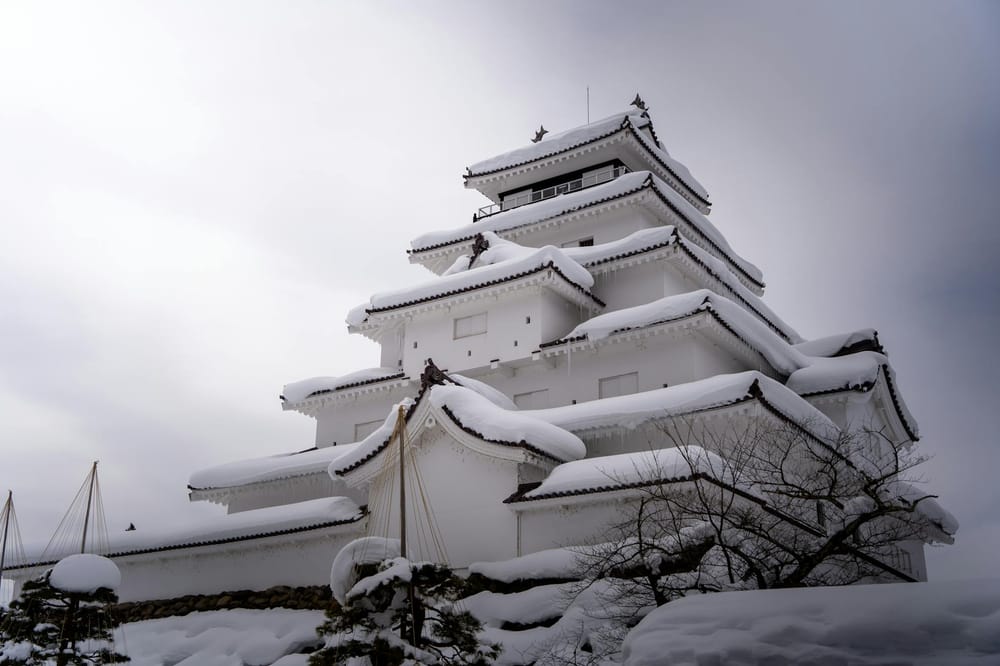
Tsurugajo Castle is the symbolic heart of Aizu-Wakamatsu and one of Japan's Top 100 Castles. The current keep is a 1965 concrete reconstruction of the original fortress, but a 2010–2011 cosmetic restoration restored the same red-tile roof that the Byakkotai (the famous teenage "White Tiger Brigade") would have seen during the 1868 Boshin War — making this the only Japanese castle keep with red tiles. The surrounding stone walls and moats are original.
The castle keep functions as a museum, with armor, swords, and Boshin War exhibits across multiple floors, plus a CG theatrical video on Aizu history and a panoramic observation level on top.
Practical details
| Item | Details |
|---|---|
| Hours | 8:30–17:00, last admission 16:30, open year-round |
| Admission (keep only) | ¥410 adults, ¥150 elementary/junior-high students |
| Combination ticket (keep + Rinkaku tea house) | ¥520 adults |
| Address | 1-1 Otemachi, Aizuwakamatsu, Fukushima 965-0873 |
| Phone | 0242-27-4005 |
| Access | About 20 minutes from Aizu-Wakamatsu Station via the Aizu Loop Bus to "Tsurugajo Kitaguchi," then 5 minutes on foot |
The most efficient way to combine the castle with other Aizu sights is the Gururin sightseeing bus, which connects Tsuruga Castle, Iimori Hill (Byakkotai memorial), and Bukeyashiki samurai residence on a roughly 40-minute loop with departures every 30 minutes.
Best times to visit
- Mid-to-late April: Cherry blossoms across the castle grounds
- Late September: The Aizu Autumn Festival with a 500-participant samurai procession
- Winter: Snow on the red tiles creates a dramatic contrast (heaviest snowfall January–February)
When you want a break, the Rinkaku Tea Room on the castle grounds serves freshly prepared matcha for an additional ¥600 with snack, separate from castle admission.
2. Ouchi-juku: An Edo-period post town frozen in time
Halal status of the site: ⚠ Walking the village is fine; food vendors are not halal-certified. Bring snacks or plan a meal at one of the halal-friendly options on the Fukushima Travel model route.
Last verified: May 13, 2026
Why Ouchi-juku is special
Ouchi-juku is a preserved post town in Shimogo, Minamiaizu District, about 20 km south of Aizu-Wakamatsu. It developed around 1640 along the Aizu Nishi Kaido, the trade and travel route linking Aizu with Nikko and Edo, and travelers would stop here to rest, eat, and resupply during the Edo period.
In 1981, Ouchi-juku was designated as an Important Preservation District for Groups of Traditional Buildings, after which preservation efforts revived it as one of Fukushima's most-visited destinations. About 30 thatched-roof houses line a single 400-meter main street, with no overhead power or telephone wires (they have been buried underground to preserve the historical view).
Most of the houses are now small soba restaurants, minshuku inns, or souvenir shops. The signature local dish is negi soba — cold buckwheat noodles eaten using a single long green onion as both chopstick and condiment. The former Honjin, the inn once reserved for high-ranking government officials, is now a folk museum displaying Edo-period dishware, clothing, and furniture.
For the postcard view, climb the stone staircase next to the Koyasu Kannon hall at the back of the village to reach the observation deck overlooking the entire main street.
Practical details
| Item | Details |
|---|---|
| Address | Ouchi, Shimogo-machi, Minamiaizu-gun, Fukushima |
| Official website | ouchi-juku.com (multi-language: English, Thai, Chinese) |
| Phone (Ouchijuku Kanko Kyokai) | 0241-68-3611 |
| Admission | Free to enter the village; parking ¥400 |
| Nearest station | Yunokami Onsen on the Aizu Railway, 35 minutes from Aizu-Wakamatsu Station (¥1,060 one way, or ¥860 with the Japan Rail Pass) |
| From Yunokami Onsen Station | 10-minute taxi (around ¥2,000), or the seasonal Saru-yu-go shuttle bus |
| Recommended stay | 2–3 hours for the village; full day if combining with nearby sights |
Festival timings
- Ouchi-juku Snow Festival: Second Saturday and Sunday of February each year. Locals carry sacred fires and light hand-carved snow lanterns at nightfall, creating a candlelit village scene.
- Hange Festival: Held in July; villagers in traditional attire carry a portable mikoshi shrine through the town, offering prayers for safe homes and a good harvest.
Winter 2026 tip: the Aizu Winter Sightseeing Bus
For the 2025–2026 winter, Fukushima Travel is operating an Aizu Winter Sightseeing Bus from January 14 to March 22, 2026, that pairs Tsurugajo Castle and Ouchi-juku in a single guided day trip including a negi-soba lunch. The fare is ¥7,230 for adults (including a ¥730 processing fee) and ¥5,450 for children, and tickets are sold through the Fukushima Travel website. Lunch is fixed to negi-soba at Ouchi-juku, so if you need a halal-friendly alternative we recommend asking Fukushima Travel in advance about substitutions or eating before/after the tour.
3. British Hills: A medieval English village deep in the mountains
Halal status of the site: ❌ Restaurants serve traditional British cuisine including roast beef, not halal-certified. ✅ The grounds, afternoon tea cafe (verify ingredients), shops, and cultural lessons remain accessible to Muslim visitors.
Last verified: May 13, 2026
Why British Hills exists in Fukushima
In the wooded hills of Tenei Village in southern Fukushima, an educational facility and accommodation complex called British Hills recreates a medieval English town across roughly 73,000 tsubo of grounds. It is operated as an English-immersion campus where Japanese students and corporate guests practice spoken English in a fully British-styled environment — manor house, pubs, refectory, gardens. The grounds also appeared as the Domyoji family mansion in the Japanese romance drama Hana Yori Dango and its sequel Hana Nochi Hare, which is why many first-time visitors recognize the buildings on arrival.
Important update vs. older guides: British Hills is no longer free to enter. As of 2026, day visitors pay a small admission fee, and an optional guided tour is available for an extra fee. Booking is required for the courtesy shuttle and the restaurant.
Practical details
| Item | Details |
|---|---|
| Day-visitor admission | ¥200 adults (junior high and older), ¥100 elementary students, free for pre-schoolers |
| Address | 1-8 Shibakusa, Tarao, Tenei-mura, Iwase-gun, Fukushima 962-0622 |
| Phone | 0248-85-1313 |
| Optional facility tour | ¥600 in addition to admission |
| Access | About 40 minutes by courtesy bus from JR Shin-Shirakawa Station (Tohoku Shinkansen); reservation required by 17:00 the previous day |
| Hours | Vary by facility; the grounds are open daily, the restaurant requires reservation |
What Muslim visitors can do at British Hills
- Tour the grounds — the manor house, gardens, and shops are open to day visitors with the admission ticket
- Shop for UK-imported goods at on-site stores
- Take an English lesson or workshop — these run regularly; check the official site for the current schedule
- Photograph the Hana Yori Dango exteriors
- Afternoon tea at the cafe is possible if you confirm ingredients carefully with staff (the cafe operates within a non-halal kitchen, so this falls under "Muslim-friendly with caveats" rather than confirmed halal). The full Refectory dinner features British roast beef and is not suitable.
For a meal, we recommend eating before you arrive or planning your halal meal back in Aizu-Wakamatsu or Shin-Shirakawa.
4. Lake Hibara (Hibara-ko): Frozen lake and wakasagi smelt fishing
Halal status of the site: ✅ Outdoor activity, no food concerns to participate. ⚠ The post-fishing fry-up traditionally includes the smelt you caught (a permissible fish species), but the cooking oil at guide shops may not be separated from other items. Bring your own oil-free preparation or eat back at your lodging if you have concerns.
Last verified: May 13, 2026
What you can do at Lake Hibara
Lake Hibara is the largest lake in the Urabandai highlands, formed in 1888 when an eruption of Mount Bandai created a natural dam that submerged whole villages. It sits inside Bandai-Asahi National Park, covers 10.7 square kilometers, and has a shoreline of roughly 31 km dotted with small islands.
In summer, the lake is a base for canoeing, kayaking, and lakeside trails (a 4-km lakeside path runs along the eastern shore with a suspension bridge as the highlight). In winter, the surface freezes solid enough that operators set up heated dome tents and shuttle visitors out by snowmobile to fish for wakasagi (Japanese pond smelt) through holes drilled in the ice.
Wakasagi (smelt) fishing season
The official wakasagi season at Lake Hibara runs November 1 to March 31, but the lake typically freezes from mid-January onward, which is when you can experience the iconic "walking on ice + heated dome" version of the activity. Outside the frozen window, fishing is done from dome boats. Most operators include rod, tackle, bait, transfer by snowmobile or motorboat, and a post-fishing tempura of your own catch in a single package.
Practical details
| Item | Details |
|---|---|
| Region | Kitashiobara Village, Yama-gun, Fukushima |
| Season | Wakasagi fishing November 1 – March 31 (ice fishing typically mid-January onward) |
| Participation age | Generally from elementary school first grade and up |
| Access from Tokyo | Tohoku Shinkansen to Koriyama, then JR Banetsu West Line to Inawashiro Station, then Bandai Toto bus to the Urabandai-Kogen bus stop (about 2 hours 40 minutes total) |
| Reservation | Required; book in advance via operators listed on the Urabandai Tourism Association website |
The lake also offers a 35-minute sightseeing cruise and snowshoeing trails through the surrounding forest in winter.
At-a-glance comparison: Which gem fits your trip?
| Site | Best season | Time needed | Admission | Halal practicality |
|---|---|---|---|---|
| Tsuruga Castle | Cherry blossom (mid-April), autumn, winter | 1–2 hours | ¥410 (keep) / ¥520 combo | ✅ Walking the grounds is fully fine |
| Ouchi-juku | Year-round; Snow Festival mid-Feb | 2–3 hours | Free (parking ¥400) | ⚠ Food on-site is not halal — eat before or after |
| British Hills | Year-round; market events Golden Week | Half day | ¥200 | ⚠ Grounds yes, restaurants no |
| Lake Hibara | Winter (Jan–Mar) for ice fishing; summer for canoe | Half to full day | Activity fees vary | ✅ Activity itself; ⚠ post-fishing fry |
How to handle halal-friendly meals in Aizu
Aizu is honest about its halal landscape: there are very few certified halal restaurants in the Aizu basin itself, and the famous local dishes (sauce katsudon, kozuyu festival soup, Kitakata ramen) typically use pork or non-halal beef. Fukushima Prefecture's own halal-friendly model route page is the most reliable starting point and lists the small number of properties around the Aizu / Urabandai area that have committed to Muslim-friendly menus on reservation.
Our practical recommendations:
- Plan halal meals in Tokyo before your Shinkansen — pick up bento or onigiri at major konbini, choosing items with seafood, vegetable, or egg fillings and avoiding anything with mirin-rich seasoning or pork-based emulsifiers.
- Reserve Muslim-friendly menus in advance at any lodging or restaurant Fukushima Travel lists on its halal-friendly model route, since most properties in the area prepare these only on request.
- Carry a Muslim dietary card in Japanese (we publish a free Halal Navi Muslim Dietary Card) to communicate restrictions to staff at soba and katsudon restaurants who may not have English menus.
- Use the prayer-time and qibla resources at Aizu-Wakamatsu prayer times while traveling.
For full halal dining choices in Tokyo before or after your Aizu trip, our Halal Navi restaurant database lists over 800 user-verified halal restaurants across Japan.
Frequently Asked Questions
How do I get to Aizu from Tokyo as a Muslim traveler?
The fastest route is the JR Tohoku Shinkansen from Tokyo Station to Koriyama (about 90 minutes), then transferring to the JR Banetsu West Line to Aizu-Wakamatsu Station (about 70 minutes). The journey takes roughly three hours total and is covered by the Japan Rail Pass. Pack halal-friendly bento from Tokyo Station's konbini before boarding, since dining options near the smaller Aizu-line stations are limited.
Is any food at Ouchi-juku halal-certified?
No. As of May 2026, none of the soba shops or food vendors along the Ouchi-juku main street hold halal certification. Most negi soba dipping sauces contain mirin (cooking sake) and bonito-based dashi. If you want to experience negi soba in concept, we recommend ordering it elsewhere from a halal-friendly chef or visiting Ouchi-juku for the architecture and history only.
Can Muslim travelers eat at British Hills?
Not in the main Refectory restaurant — its signature is British-style roast beef. The on-site shops sell packaged UK imports (chocolates, teas, biscuits) that you can read ingredient labels on, and the afternoon tea cafe may have items free of haram ingredients if you confirm with staff. The cafe is not a halal-certified kitchen, so cross-contamination cannot be ruled out. Plan a real meal before or after your visit.
Is Tsuruga Castle wheelchair-accessible?
The castle grounds and park are largely flat and accessible. The keep itself has steep wooden stairs between floors, which can be challenging for visitors with mobility difficulties. The top observation level is reached only by climbing the full keep. Audio guides are available for rent and English signage exists but is limited.
When does Lake Hibara freeze enough for ice fishing?
The wakasagi season opens November 1, but the lake typically freezes thickly enough for on-ice tent fishing from mid-January through late March. Before mid-January, fishing is still possible from heated dome boats on open water. Always book through a licensed Urabandai operator, never venture onto the ice without a guide.
Is there a prayer room near any of these four sites?
There is no dedicated mosque or prayer room at Tsuruga Castle, Ouchi-juku, British Hills, or Lake Hibara itself. Some accommodations along the Fukushima Travel halal-friendly model route can provide a quiet prayer space on request when you reserve a Muslim-friendly menu. Otherwise, plan to pray in your hotel room and refer to Aizu-Wakamatsu prayer times and qibla to set direction.
How current is the admission fee for British Hills?
The ¥200 day-visitor admission was confirmed via the Japan Travel and GLT-JP listings in May 2026. Older guides (including pre-pandemic articles) sometimes list British Hills as free; that information is outdated. The optional ¥600 facility tour and accommodation-package pricing are separate from day admission.
Can I do all four sites in one trip?
Yes, but not in one day. The recommended pattern is a two- or three-day trip: Day 1 covers Tsuruga Castle and Ouchi-juku (the Fukushima Winter Sightseeing Bus pairs these in winter); Day 2 covers Lake Hibara and the Urabandai area; British Hills is a half-day detour better reached from Shin-Shirakawa Station on the way in or out, rather than from Aizu-Wakamatsu.
Is the prefectural "halal-friendly model route" trustworthy?
It is published by Fukushima Travel, the prefectural government's official tourism portal. The page links halal-relevant restaurants and lodgings directly to the Ouchi-juku / Tsurugajo / Urabandai itinerary. The route is "Muslim-friendly" rather than fully halal-certified, so individual properties still vary — we recommend confirming halal preparation directly with each property at the time of reservation.
Verdict
Aizu is a rare Tohoku region that combines castle history, samurai culture, an Edo-period thatched village, a frozen lake, and a quirky British-themed mountain campus inside a single three-day window from Tokyo. It is not yet a halal-rich destination — outside of the prefectural model route, you will need to plan ahead — but the major sites themselves are entirely walkable as a Muslim traveler, and the local government has taken concrete steps to publish Muslim-friendly options that almost no other Japanese prefecture publishes at this level of integration.
Our advice for 2026: book your Muslim-friendly meals before you leave Tokyo, carry a dietary card and prayer-time reference, and treat Aizu as a "see, not eat" trip with two or three pre-confirmed meal stops along the way. The reward is some of the most photogenic and historically dense scenery anywhere in northern Japan.
Sources & references
- Fukushima Travel — Tsurugajo Castle official page, accessed May 13, 2026. Accessed 2026-05-15.
- Fukushima Travel — Ouchi-juku official page, accessed May 13, 2026. Accessed 2026-05-15.
- Fukushima Travel — Halal Friendly Model Route, accessed May 13, 2026. Accessed 2026-05-15.
- Fukushima Travel — Aizu Winter Sightseeing Bus 2026 schedule, accessed May 13, 2026. Accessed 2026-05-15.
- British Hills official site — british-hills.co.jp, accessed May 13, 2026. Accessed 2026-05-15.
- Japan Travel — British Hills admission and access, accessed May 13, 2026. Accessed 2026-05-15.
- Samurai City Aizu-Wakamatsu — Tsuruga Castle hours and fees, accessed May 13, 2026. Accessed 2026-05-15.
- Japan Guide — Ouchijuku access from Aizu-Wakamatsu and Nikko, accessed May 13, 2026. Accessed 2026-05-15.
- National Parks of Japan — Snow Activities on Lake Hibara, accessed May 13, 2026. Accessed 2026-05-15.
- Live Japan — Ouchi-juku winter and Snow Festival timing, accessed May 13, 2026. Accessed 2026-05-15.
About this article
Author: Aisha Rahman writes for Halal Navi's editorial team, covering halal-friendly travel in Japan with a focus on Tohoku and Kanto regions.
Reviewer: This article was reviewed by Halal Navi's Halal Verification Team, which cross-checks each venue and certification claim against the cited primary source before publication. See our editorial standards for the full review process.
Update policy: We re-verify every claim in this article quarterly. If you spot outdated information — particularly admission fees, hours, or seasonal bus operations — please contact us and we will correct within seven days.
Disclosure: Halal Navi receives no advertising revenue from any venue, transportation operator, or activity provider mentioned in this article. Recommendations reflect independent editorial judgment.
Last verified: 2026-05-15